A 4K security camera identifies faces at 70 feet. A 1080p camera tops out at 30 feet. In a driveway or front yard, that difference is the gap between usable footage and a blurry guess. Here is the honest guide to choosing the right HD resolution for your home.
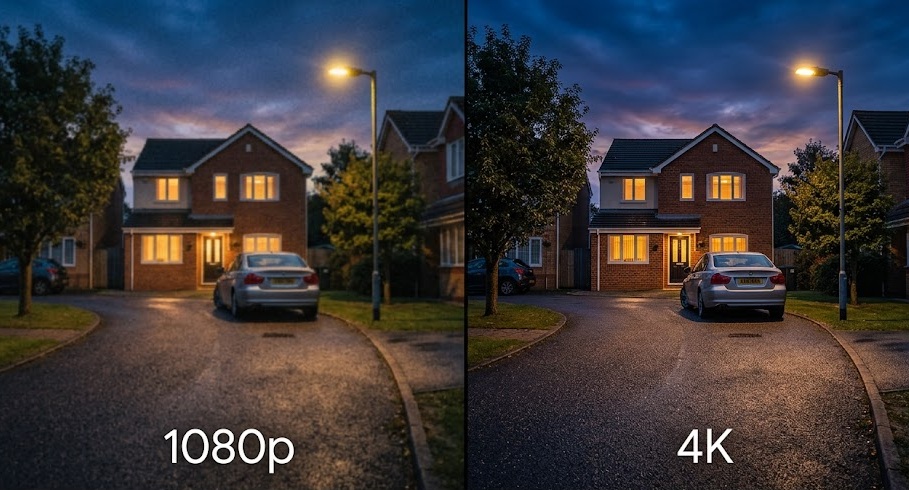
4K is the standard in 2026 for outdoor security cameras. It captures 8.3 megapixels — four times the detail of 1080p. You can digitally zoom in on recorded footage and still identify faces, license plates, and clothing at distances up to 70 feet. For small indoor rooms under 15 feet, 1080p is still sufficient. For anything outdoors or any space larger than a bedroom, get 4K.
Resolution is measured in total pixels. More pixels means more detail. More detail means you can zoom in further on recorded footage without the image turning into a blur.
| Resolution | Megapixels | Pixels Total | Face ID Distance | License Plate |
|---|---|---|---|---|
| 1080p (Full HD) | 2.1 MP | 2,073,600 | 20–30 feet | 15–20 feet |
| 2K (QHD) | 3.7 MP | 3,686,400 | 30–40 feet | 25–30 feet |
| 4K (UHD) | 8.3 MP | 8,294,400 | 50–70 feet | 40–50 feet |
The gap between 1080p and 4K is not cosmetic. At a 40-foot driveway, a 1080p camera gives you a blurry silhouette. A 4K camera gives you a face you can recognize in court. This is the difference that matters after an incident actually happens.
When you record at 4K and zoom in on a person in the footage, you are cropping into 8.3 megapixels of captured detail. That person's face fills the frame clearly. When you do the same with 1080p footage, you are cropping into 2.1 megapixels. The face pixelates into an unidentifiable blur at the same zoom level.
This is why 4K matters most not in live viewing, but in reviewing recorded footage after an event. You captured everything at full resolution. You can find the detail in post, even if you did not know you needed it at the time.
A vehicle involved in a driveway theft is parked 30–40 feet from most cameras. A 1080p camera captures the plate as a smear of pixels at that distance. A 4K camera captures it legibly. This is the single most-cited difference between security camera footage that helps police and footage that does not.
4K cameras typically pair high resolution with wider lens angles — 110 to 120 degrees is common. A wider view means one 4K camera can cover the area that previously required two 1080p cameras. The higher upfront cost is partially offset by covering more ground with fewer units.
Before buying, look up sample footage from the exact camera model you are considering — not marketing renders, but actual user-uploaded recordings. Watch how the image handles zooming in on a person at 30+ feet. That is the footage you will have when something happens at your home. Does it look usable?
Any outdoor space where people or vehicles approach from more than 25 feet. 4K is the right choice here — period. The face identification distance gap between 4K and 1080p is most impactful outdoors, and outdoor cameras are where incidents actually happen.
Even at close range, 4K gives you detail for identification and digital zoom. Porch and entry cameras are often the most legally important cameras in your home. The small cost difference between 1080p and 4K is irrelevant compared to the detail difference in critical footage.
In a 12x15 foot room, the camera is never more than 20 feet from any point. 1080p captures full face detail at that distance. Saving money on indoor cameras is reasonable. Spend the difference on better outdoor 4K cameras instead.
Tight spaces where the camera-to-subject distance is always under 15 feet. A 1080p camera is more than adequate here. Motion detection matters more than resolution in these locations. Budget accordingly.
Higher resolution means larger files. Here is the actual math so you can plan accordingly.
| Resolution | Codec | Daily Storage (24/7) | 1 TB Holds | 2 TB Holds |
|---|---|---|---|---|
| 1080p | H.264 | 25–40 GB/day | 25–40 days | 50–80 days |
| 1080p | H.265 | 12–20 GB/day | 50–80 days | 100+ days |
| 4K | H.264 | 100–150 GB/day | 6–10 days | 13–20 days |
| 4K | H.265 | 50–75 GB/day | 13–20 days | 26–40 days |
Key insight: H.265 codec cuts storage requirements by 50% at the same quality. Any 4K camera you buy in 2026 should support H.265. Without it, a 4K system becomes storage-prohibitive for home users. Always verify H.265 support before purchasing.
For most home setups using event-only recording (motion-triggered rather than continuous), actual daily storage is under 5–10 GB per camera even at 4K — because cameras only record when there is movement.
Cloud storage subscriptions that charge by storage used will cost significantly more at 4K. If you plan to use cloud-only storage, factor in the higher cost of storing 4K footage. Local storage (NAS, NVR with hard drive, or MicroSD card) is far more cost-effective for high-resolution continuous recording.
4K (8MP) PoE camera. AI person and vehicle detection. Color night vision with spotlight. H.265. IP66 weatherproof. 100-foot infrared night vision range. Single Ethernet cable powers and connects the camera. Best value 4K outdoor camera in 2026 — professional-grade specs at a budget price.
Dual-lens: 4K wide angle + 2K telephoto. Solar-powered — no outlet needed outdoors. Local storage included with no subscription. AI person detection. IP67 rating. The solar charging removes the need to ever replace batteries. Best all-in-one outdoor 4K wireless camera at under $100.
4-camera 4K PoE system with NVR and 2 TB hard drive included. 24/7 continuous recording out of the box. AI detection, H.265, color night vision. No subscription ever required. Best complete 4K home security system under $300 — includes everything needed for permanent installation.
2K (1440p) resolution — technically above 1080p. Color night vision. AI motion detection with free 14-day event clips. No subscription required. MicroSD slot for local recording. Best-value HD security camera when budget is the primary constraint. Covers small indoor spaces completely.
The Reolink RLC-810A delivers 8MP professional-grade video at $69.99. One camera. No subscription. Identifies faces at 70 feet. Install it this weekend.
Read the Full IP Camera Guide →