Every language you have heard of — Python, Java, JavaScript, C# — is a high level language. Here's what that actually means, why it matters for beginners, and how to pick the right one for your goals.
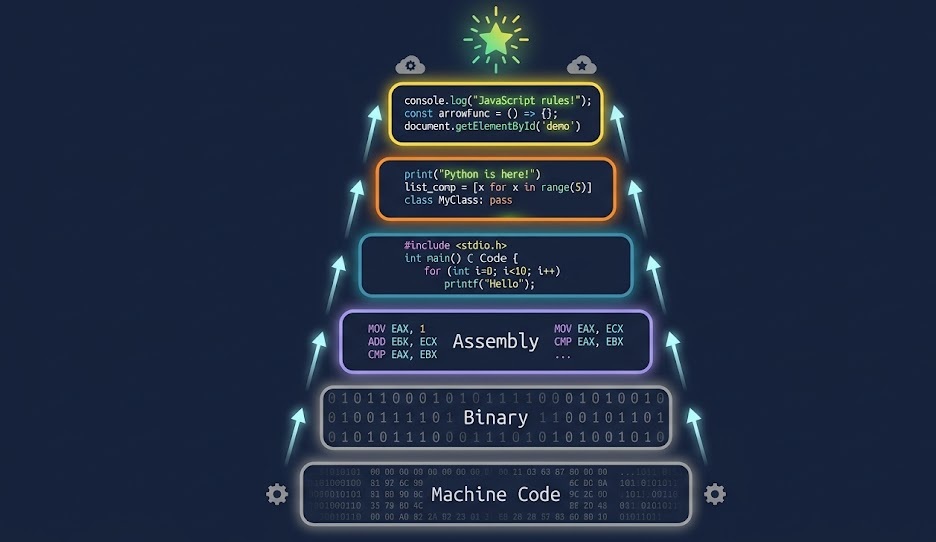
A high level coding language is a programming language that hides hardware complexity — memory addresses, processor instructions, register management — so you can write code that describes what you want to do, not how the hardware should do it. Python, Java, JavaScript, C#, Swift, Ruby, and Kotlin are all high level languages. The opposite is a low level language: Assembly and machine code, where you write raw processor instructions. Almost all modern software development uses high level languages.
Imagine you want to move a file on your computer. In a high level language like Python, you write:
import shutil
shutil.move("old_path/file.txt", "new_path/file.txt")
Two lines. Done. The language handles the rest: opening file handles, reading bytes, writing them to a new location, updating the file system, closing the handles, and freeing the memory used in the operation.
In a low level language — or hardware-level code — you would need to manage each of those steps manually. Hundreds of lines. Direct memory addresses. Architecture-specific instructions.
"High level" means you are working with abstractions that represent human concepts — files, lists, functions — rather than raw hardware operations. The further you are from the hardware, the higher the level.
The distinction is not about difficulty — it is about control vs. convenience.
Print numbers 1 to 5:
for i in range(1, 6):
print(i)Print numbers 1 to 5:
section .data
  fmt db "%d", 10, 0
section .text
  extern printf
  global main
main:
  push rbp
  mov ecx, 1
.loop:
  cmp ecx, 6
  jge .end
  push rcx
  mov esi, ecx
  lea rdi, [fmt]
  xor eax, eax
  call printf
  pop rcx
  inc ecx
  jmp .loop
.end:
  pop rbp
  ret
The same result. The high level version focuses on the intent. The low level version manages every register, stack frame, and memory alignment manually.
| High Level | Low Level | |
|---|---|---|
| Examples | Python, Java, C#, JavaScript, Swift | Assembly, Machine Code |
| Readability | High — resembles English | Low — processor instructions |
| Memory management | Automatic (garbage collection) | Manual |
| Hardware control | Limited | Full |
| Portability | High — runs on multiple architectures | Low — architecture-specific |
| Speed | Slower (abstraction overhead) | Fastest possible |
| Who uses it | Almost all developers | Embedded systems, OS kernels, firmware |
C is often called a "mid-level" language. It is compiled directly to machine code (low-level characteristic) but has readable syntax and portable code (high-level characteristic). C gives you direct memory control without requiring you to write raw Assembly. Operating systems, embedded systems, and databases are typically written in C for this reason.
According to the 2025 Stack Overflow Developer Survey and TIOBE Index, these are the most widely used high level languages:
The most popular language worldwide. Dominant in data science, machine learning, AI, scripting, and automation. Syntax is minimal and readable. Best first language for most beginners.
The language of the web. Runs in every browser. Powers front-end interfaces, back-end servers (Node.js), and mobile apps (React Native). If you want to build websites, start here.
Enterprise backends, Android apps, big data infrastructure. Statically typed, verbose, and strict. Used in over 3 billion devices. The primary language in university CS programs.
Microsoft's flagship language. Powers Unity game engine, Windows desktop apps, ASP.NET web apps, and enterprise software. Similar to Java but considered more modern.
Apple's language for iOS and macOS development. Required for native iPhone/iPad apps. Launched in 2014 to replace Objective-C. Cleaner syntax, safer memory model.
The modern replacement for Java on Android. Google's preferred language for Android development since 2019. Interoperable with Java — you can mix both in the same project.
Known for Ruby on Rails — the web framework that powered Twitter, GitHub, and Shopify's early days. Elegant, expressive syntax. Smaller market than Python or JavaScript but still active.
Still powers approximately 77% of all websites with a known server-side language (including WordPress). Often dismissed but widely deployed. Running half the internet is not nothing.
High level languages are not objectively better than low level. They are a trade-off. Understanding the trade-off helps you know when low level knowledge actually matters.
| You Gain | You Lose |
|---|---|
| Faster development — write in hours, not weeks | Raw performance — abstraction adds overhead |
| Portability — same code runs on different hardware | Hardware control — can't directly manage memory |
| Automatic memory management (no memory leaks) | Unpredictable pauses from garbage collection |
| Readable, maintainable code | Less insight into what the hardware is actually doing |
| Huge libraries and frameworks | Dependency overhead and security surface area |
| Large developer communities | Language version fragmentation over time |
For 99% of software projects — web apps, mobile apps, enterprise software, data analysis, automation — high level languages are the right choice. The performance overhead is negligible compared to the development speed advantage.
The 1% where low level matters: operating systems, device drivers, embedded firmware, real-time systems, and game engines. Even then, the interface code is usually high level — only the performance-critical core is written in C or Assembly.
The answer depends entirely on what you want to build. Here is the fastest path for each goal:
| Your Goal | Start With | Why |
|---|---|---|
| General programming / first language | Python | Minimal syntax, immediate results, covers all fundamentals |
| Web development (front-end) | JavaScript | Runs in every browser — no setup required |
| Web development (full-stack) | JavaScript (Node.js) | One language for both front and back end |
| Data science / AI / machine learning | Python | NumPy, Pandas, TensorFlow, PyTorch all use Python |
| Android app development | Kotlin | Google's official preferred Android language |
| iOS / macOS app development | Swift | Required for native Apple platform development |
| Game development | C# (Unity) | Largest indie game ecosystem |
| University CS / AP exam | Java | AP Computer Science A; most university intros |
| Enterprise / backend jobs | Java or C# | Dominant in large company backends |
Learn Python. It has the lowest barrier to entry, the widest applicability, and the best job market for beginners. Every programming concept you learn in Python transfers directly to every other language. You will not regret starting with Python — but you might regret stalling because you tried to pick the perfect language first.
No high level language is objectively better than all others. Python is slow but readable. Java is verbose but scalable. JavaScript is quirky but universal. Professional developers know 3–5 languages and pick the right tool for each job. Your first language just needs to get you coding. The rest comes with time.
Python runs in your browser at python.org/shell — no download required. Write your first line of code in the next 60 seconds. You already know enough to start.
Try Python in Your Browser