What's in this guide
How Online AI Detection Tools Work
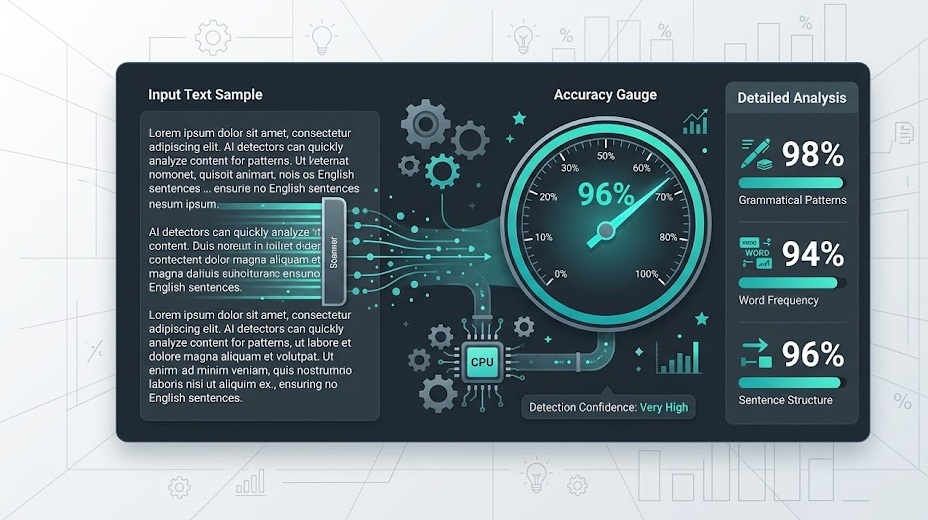
AI detectors don't "know" if text is AI-written. They measure statistical patterns.
Human writing is unpredictable. It drifts in rhythm, uses surprising word choices, and varies sentence length in ways that feel natural but are hard to replicate consistently.
AI-generated text is different. It tends to pick the statistically likely next word — making it measurably more uniform.
Detectors exploit that difference using two main signals:
- Perplexity — how surprised a language model is by each word choice. Low perplexity = predictable = more likely AI.
- Burstiness — how much sentence length varies. Humans burst between short and long sentences. AI stays flat.
The detector runs your text through its model, scores these signals, and returns a probability. It never gives a guaranteed verdict — only a likelihood score.
Accuracy in 2026: What the Data Actually Shows
Independent benchmarks in 2026 paint a clear picture.
| Tool | Detection Rate | False Positive Rate | Free Tier |
|---|---|---|---|
| Originality.ai | 96.2% | ~2% | No |
| Winston AI | 96% | 3–4% | Limited |
| Turnitin | 92% | 3% | Institutional only |
| GPTZero | 92.4% | 0.24% | Yes |
| EyeSift | ~88% | ~5% | Yes (unlimited) |
| ZeroGPT | ~83% | 18% | Yes |
These numbers apply to unmodified AI text. The story changes fast when content is edited.
The gap between vendor claims and independent test results has widened in 2026. Always check third-party benchmarks — not the tool's own marketing page.
Top Online AI Detection Tools Ranked
Originality.ai
96.2% accuracy. Best for publishers and agencies. Scans full websites, not just single documents. Paid only.
Winston AI
96% detection, OCR support for scanned documents. Strong for academic institutions and editors. Best-in-class among paid tools.
GPTZero
92.4% accuracy with only 0.24% false positives — the lowest false positive rate tested. Free tier available. Best balance for general use.
Turnitin
92% accuracy, 3% false positives. Institutional access only. The standard in education. Highlights sentence-level AI probability.
EyeSift
~88% accuracy, no sign-up required, no monthly cap. Best free tool for casual or one-off checks. Straightforward results.
ZeroGPT
15,000 characters per scan with no registration. Useful for quick checks, but 18% false positive rate — the highest of any major tool.
Real Limits You Need to Know
False positives target specific groups
Non-native English speakers write with consistent, structured patterns — and get flagged at much higher rates.
Technical writers, students following strict rubrics, and neurodivergent writers face the same problem.
A high AI probability score is not proof of cheating. It's a signal that warrants review, not automatic judgment.
Humanization defeats most detectors
Tools that "humanize" AI text by rewriting it to lower perplexity are effective. Most detectors fall below 40% accuracy on humanized output.
This means detectors are best at catching unedited, raw AI output — not sophisticated misuse.
No detector agrees with itself 100%
Run the same text through three detectors and you'll often get three different scores. Use them as a signal — never as a verdict on their own.
Who Should Use an AI Detection Tool
Teachers & Professors
Use Turnitin (institutional) or GPTZero for student submissions. Never make a decision on score alone — always verify with a conversation.
Publishers & Editors
Originality.ai is built for this use case. Scan full content batches and track writers over time. Worth the paid plan for high-volume work.
Businesses & HR
Screening job applications or freelance work? GPTZero or Winston AI for spot checks. EyeSift for quick, no-friction scans.
Content Creators
Run your own content through a detector before publishing. Helps catch over-reliance on AI drafts that could hurt credibility.
Frequently Asked Questions
Work Smarter, Not Harder
Get practical guides on tools, productivity, and tech — straight to your inbox.
Explore The Efficient Method