The bank lights up. The cable's in. The phone screen stays dark. Before you buy a replacement — run through this. One of these seven causes is almost certainly yours.
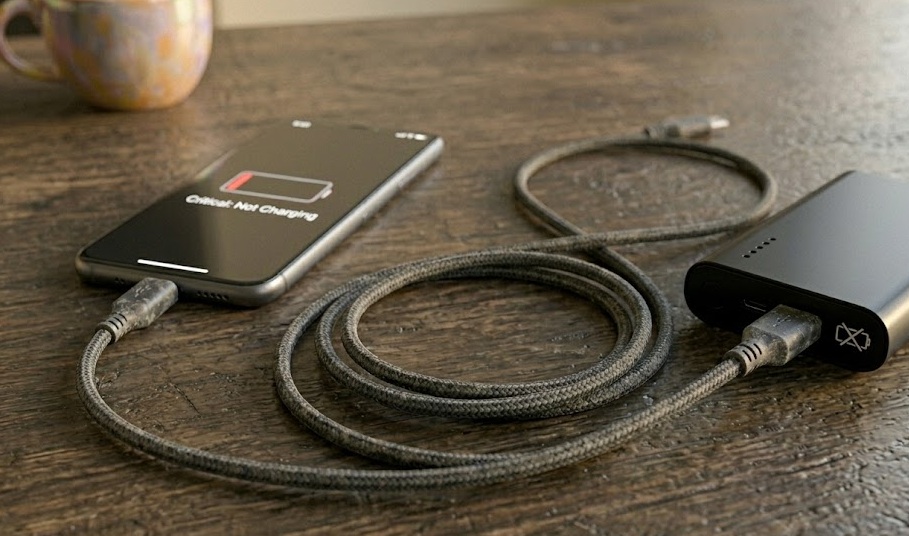
Before going cause-by-cause, this sequence narrows down the problem fast. Work through it in order.
If none of these produce any response at all — skip to Cause #5 (degraded battery) or Cause #7 (deep discharge / hardware fault).
Click any cause to expand the full explanation and fix. Start from the top — that's where most problems actually live.
A cable can look completely fine outside and be broken inside. Micro-fractures near the connector, a worn contact surface, or — the sneaky one — it was never a proper charging cable to begin with.
Millions of USB-C cables are designed only for data transfer, with power wires so thin they can barely trickle charge a device. They come bundled with gadgets, live in junk drawers, and look identical to proper cables.
A data-only cable might deliver enough power to show a faint charging icon — but at 50mA instead of 2000mA. Your phone says it's charging. It's lying. It'll be at the same percentage an hour later.
Lint compresses over time into a dense mat at the bottom of the port. The cable connector seats — might even click — but the connection is off by a fraction of a millimeter.
This affects both sides: the port on your phone and the output port on the power bank. The phone port is usually worse because it takes more daily abuse.
When a phone is at 0%, it draws nearly no current. Some power banks detect "no load," assume nothing is connected, and shut their output off after a few seconds.
The loop: bank turns on → detects nothing → turns off. The bank is not broken. The phone is not broken. They just can't start the conversation from zero.
Modern phones negotiate charging via USB Power Delivery (PD) or Qualcomm Quick Charge. Your phone sends a signal asking for 9V/2A. An older bank that only outputs 5V/1A has nothing to say back.
This is why the bank charges your old phone fine but won't touch your new one.
Every lithium-ion cell has a finite charge cycle life — roughly 300–500 cycles for standard banks. After that, internal resistance rises and the bank can no longer reliably charge a phone.
The tell: the bank dies quickly, or your phone only gets to 30% before the bank runs out.
Power banks shut down output when the internal temperature exceeds ~40°C (104°F). That's basically "left in a car on a warm day." More common than people expect.
A power bank stored unused for months can fall below a critical voltage. Some protection circuits refuse to charge cells in this state. The bank looks completely dead.
Plug into a wall adapter (5V/2A minimum — not a laptop port) and leave for 6 hours. Any light during those 6 hours = still viable. No response at all = hardware fault, time to replace.
Select what's happening right now and get a targeted answer.
Charge cycles are the real metric — not years.
At 2 charges/week: 500 cycles ≈ 5 years. At daily use: ~1.5 years. A 10,000mAh bank realistically delivers 7,000–8,000mAh due to voltage conversion losses — normal, not a defect.
Spec-transparent, PD-capable, consistent output. Each one clearly states what it delivers.
Compact. 30W PD output charges iPhone 16 to 50% in ~30 min. Output specs printed on the bank itself.
AmazonDigital display. 130W handles laptops. Refills in ~2 hours via 65W input. The display alone eliminates half the troubleshooting questions.
Amazon~$15. Plugs between cable and phone. Shows real-time V, A, W. Definitively tells you if the bank, cable, or phone is the bottleneck.
AmazonCredit-card width. Lighter than most phones. For people who forget to bring a power bank — this one fits in a shirt pocket.
Amazon