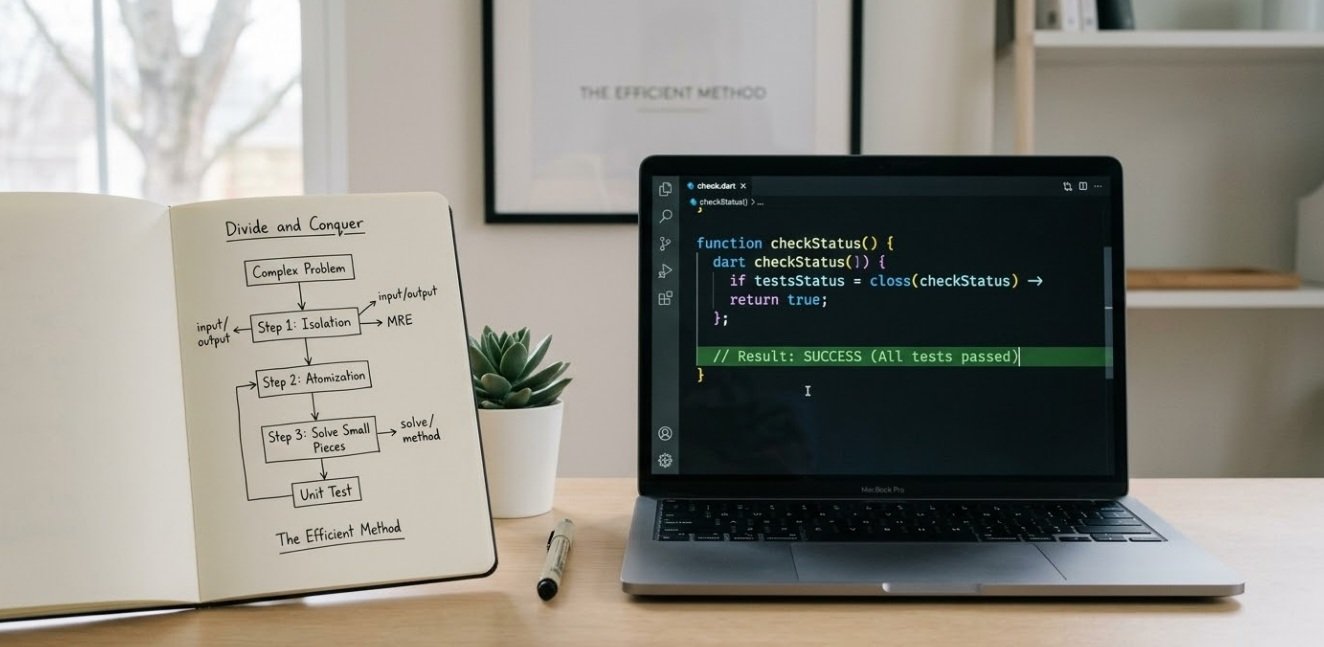
The Moment Every Programmer Knows
You are sitting in front of your computer.
Your boss gives you a new task.
“Add a login system to the app.”
Or maybe:
“There is a strange bug in the system. Can you fix it?”
At first, it sounds simple.
But after a few minutes you realize something.
There are too many parts:
- user interface
- database
- password checking
- security
- error messages
- APIs
Your brain feels full.
You look at the screen…
And you don’t know where to start.
If this has happened to you, you are not alone.
Many programmers understand programming languages very well. They can read code and understand what it does. But when they need to write a new solution, they suddenly feel stuck.
The reason is simple.
Programming is not only about writing code.
Programming is about solving problems.
And the most important skill for solving problems is this:
Break big problems into small pieces.
Why Big Problems Are Hard
When programmers see a big problem, they often try to think about everything at the same time.
For example, imagine you need to build a login system.
Your brain starts thinking about:
- user database
- passwords
- security rules
- sessions
- API calls
- user interface
That is a lot to think about at once.
The human brain does not work well this way.
When we try to solve everything at the same time, we usually do three things:
- We jump from one idea to another.
- We write messy code.
- We create new bugs.
Good programmers avoid this trap.
They do not try to solve one big problem.
They solve many small problems.
Step 1: Find the Smallest Piece
The first step is simple.
Find the smallest part of the problem that you can solve.
In the book Think Like a Programmer, the author explains this idea using puzzles and problem-solving examples.
When a problem looks big and confusing, you should not solve the whole thing at once.
Instead, ask yourself:
What is the smallest step I can do first?
Let’s look at an example.
Imagine you want to build a login system.
A beginner might think about the whole system.
But a better start is a very small function.
For example:
function checkPassword(password) {
    return password === "1234";
}
Of course, a real system is more complex.
But this small piece helps you start moving forward.
Step 2: Decide What Goes In and What Comes Out
Before writing code, good programmers think about something important.
They ask two questions:
What goes into the function?
What should come out?
This is sometimes called a contract.
For example:
Input:
- password
Output:
- true or false
That’s it.
You do not need to think about the database yet.
You do not need to think about security yet.
You only focus on the result.
The book explains that sometimes restating the problem in clear words helps you find the solution.
When the problem is clear, the code becomes easier to write.
Step 3: Start With the Most Obvious Part
Sometimes one part of the problem is easier than the others.
Start there.
In the book, the author uses the example of a Sudoku puzzle.
When solving Sudoku, the best strategy is to start with the square that has the fewest possible numbers.
Why?
Because it is the easiest place to begin.
Programming works the same way.
If one part of the system is clear, start there.
For example, imagine you are building an online store.
You might not know how to build the whole system yet.
But maybe you know how to calculate the total price.
So you start with a function like this:
function calculateTotal(items) {
    let total = 0;
    for (let item of items) {
        total += item.price;
    }
    return total;
}
Now one small part of the system works.
Step 4: Try a Smaller Version
Sometimes a problem is too big.
When this happens, try a smaller version of the problem.
The book explains that experimenting with smaller versions can help you understand the larger problem.
For example:
If you are building a search algorithm, do not start with a million records.
Start with 10.
Test your idea.
See how it works.
Small experiments often teach you important things.
Step 5: Build Momentum
There is also a psychological reason why this method works.
When you solve a small problem, you feel progress.
That small success pushes you forward.
Instead of feeling stuck, you move step by step.
For example:
- You write one small function.
- You test it.
- You add another function.
- You connect them together.
Slowly, the system grows.
Not because you knew everything from the beginning.
But because you solved problems one step at a time.
The Truth About Programming
Many people think programming is about typing code quickly.
But that is not true.
Programming is mostly thinking.
Learning the syntax of a programming language is only the first step.
The real skill is learning how to think about problems.
The book explains that problem solving in programming is a creative activity, just like writing music or painting.
And the good news is this:
Problem solving is a skill you can learn.
Final Thoughts
The next time you face a difficult programming problem, remember this idea:
Do not try to solve everything at once.
Instead:
- Find the smallest piece of the problem.
- Decide what goes in and what comes out.
- Solve one small step.
- Move to the next step.
Every large system in the world was built this way.
Not in one giant piece.
But in many small parts.
Piece by piece.
Step by step.
And that is when you truly begin to think like a programmer. 🚀